
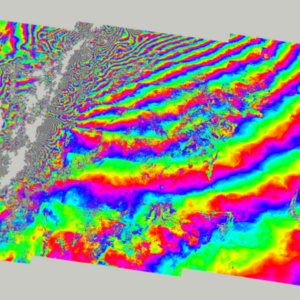
The ASF DAAC, working with NASA’s Jet Propulsion Laboratory (JPL), announces that ARIA Sentinel-1 Geocoded Unwrapped Interferogram (GUNW) On Demand processing is now available through the Vertex data portal.
ARIA-S1-GUNW products offer high-quality, geocoded unwrapped interferograms, accompanied by comprehensive metadata and correction layers for atmospheric, orbital, and noise effects. These data are designed to support a broad range of geophysical and hazard applications such as monitoring earthquakes, volcanoes, land subsidence, and other sources of surface deformation. There are currently more than one million ARIA-S1-GUNW products archived by ASF for tectonically active areas worldwide.
This new On Demand processing option allows users to generate ARIA-S1-GUNW interferograms for spatial extents and time pairings that are not currently available in the archive. These custom-generated products are added to the GUNW archive, expanding the number of products available to all users.
ARIA-S1-GUNW products use a custom framing convention to ensure consistent geospatial extents through time, making them high-quality inputs for time series analysis. Vertex’s user-friendly web interface makes it easy to identify ARIA frames in an area of interest and then search for valid date pairs to use to generate an ARIA-S1-GUNW product. Refer to the On Demand ARIA S1 GUNW Product Guide for more information.
The ARIA (Advanced Rapid Imaging and Analysis) project, a collaboration between JPL and the California Institute of Technology (Caltech), develops InSAR and other geospatial data products to support disaster response, scientific research, and long-term monitoring of Earth’s changing surface. The integration of ARIA-S1-GUNW On Demand into ASF DAAC’s Vertex platform expands access to these products and enhances NASA’s commitment to open, user-driven data services.
Funding for this project was provided through an ACCESS 2019 Program grant for Enabling Cloud-Based InSAR Science for an Exploding NASA InSAR Data Archive, David Bekaert, PI.