







The structures of different crop types vary as they develop, interacting with the polarization and phase signature of a SAR signal.
Frequent, repeated observations during a growing season can be used to determine crop types and stages of crop development. This information can be used to remotely monitor the health of a region’s agriculture throughout crop rotation, growth, and harvest.
Productivity and Desert
Location: Southern California and northern Mexico
Date(s): 2007
Spacecraft/Agency: ALOS / Japan Aerospace Exploration Agency (JAXA).
Credit: © JAXA 2007; courtesy D. Atwood.
This Advanced Land Observation Satellite (ALOS) AVNIR-2 near-infrared image shows the stark contrast between the productive agricultural region of the Imperial Valley (red-colored fields) and the Sonoran Desert of southern California and northern Mexico. AVNIR-2 was a visible and near infrared radiometer used to observe land and coastal zones. AVNIR-2 imagery provides good historical spatial land-coverage and land-use classification maps for monitoring regional environments.

Stages of Vegetation
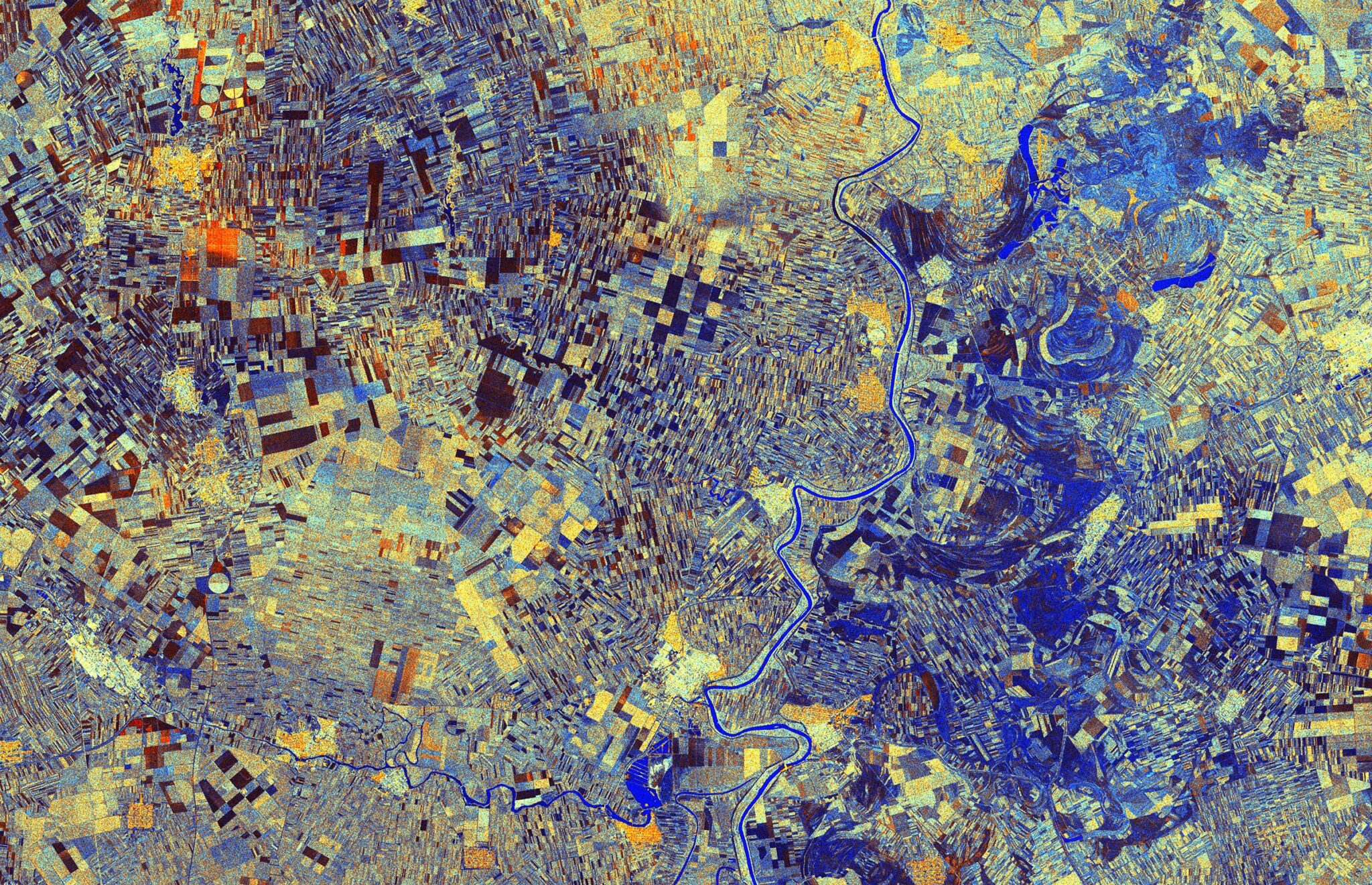
Location: Serbia
Date(s): 2017
Spacecraft/Agency: Sentinel-1 / European Space Agency (ESA).
Credit: Contains modified Copernicus Sentinel data 2017; courtesy J. Hickey.
This multi-temporal Sentinel-1 image was generated using multiple image polarizations, where different colors indicate different stages of vegetation development. Located in the region of Vojvodina in northern Serbia, the agricultural fields create a distinct pattern of geometric shapes. Among the fields, there are a number of small towns with gridded layouts inspired by ancient Greece’s Hippodamus, known as the father of European urban planning.
Land-use Classification
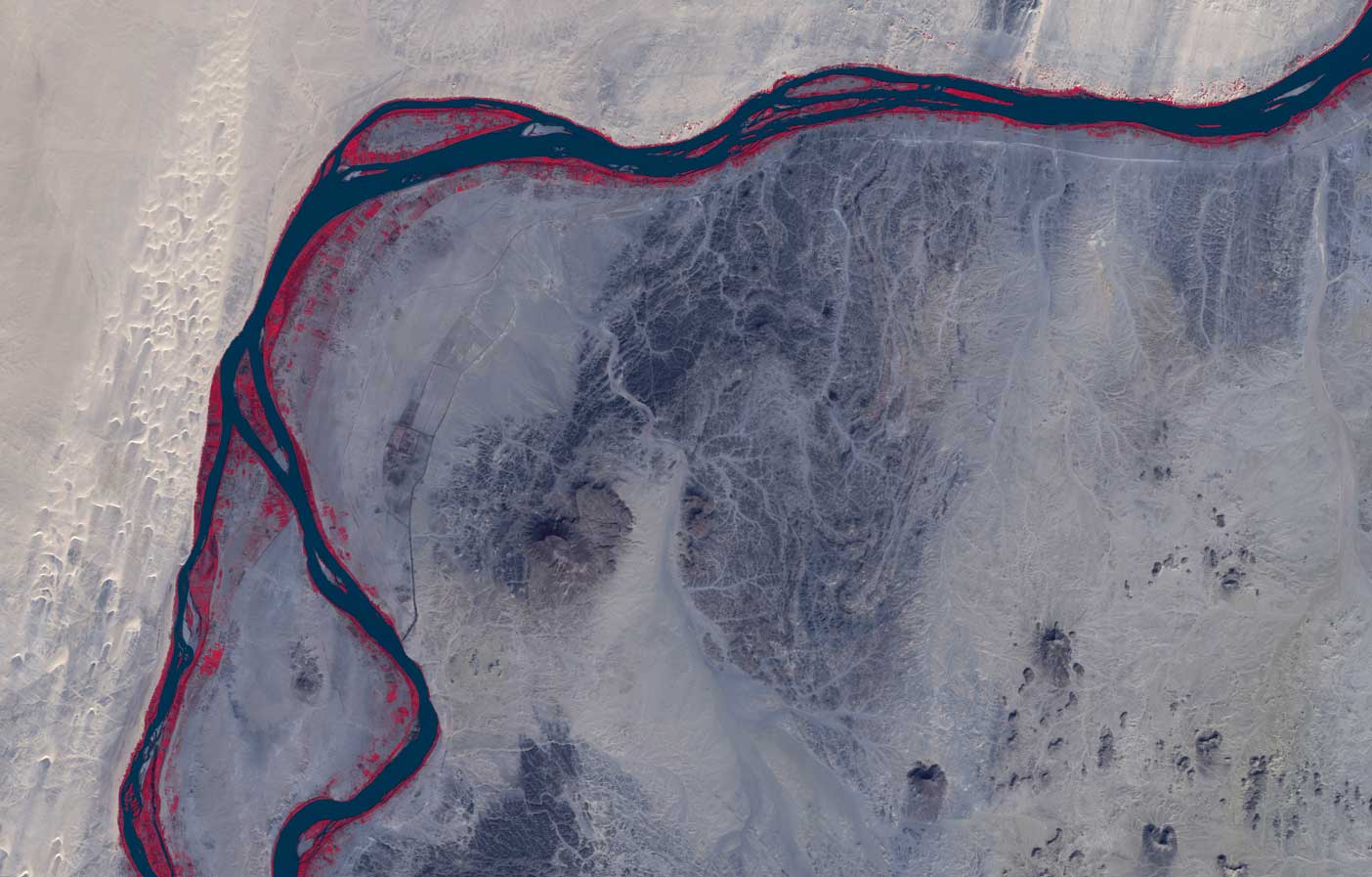
Location: Sudan
Date(s): 2010
Spacecraft/Agency: ALOS / Japan Aerospace Exploration Agency (JAXA).
Credit: © JAXA 2010.
The Nile River runs through this Advanced Land Observation Satellite (ALOS) AVNIR-2 image, separating the rocky and rugged Nubian desert east of the river from the sandy Libyan desert to the west. The near-infrared capability of the satellite sensor makes vegetation growing along the river quite pronounced, especially in contrast to the rock and sand of the desert. The AVNIR-2 radiometer was designed to aid in the creation of high-quality land coverage and land-use classification maps.

Agricultural Development
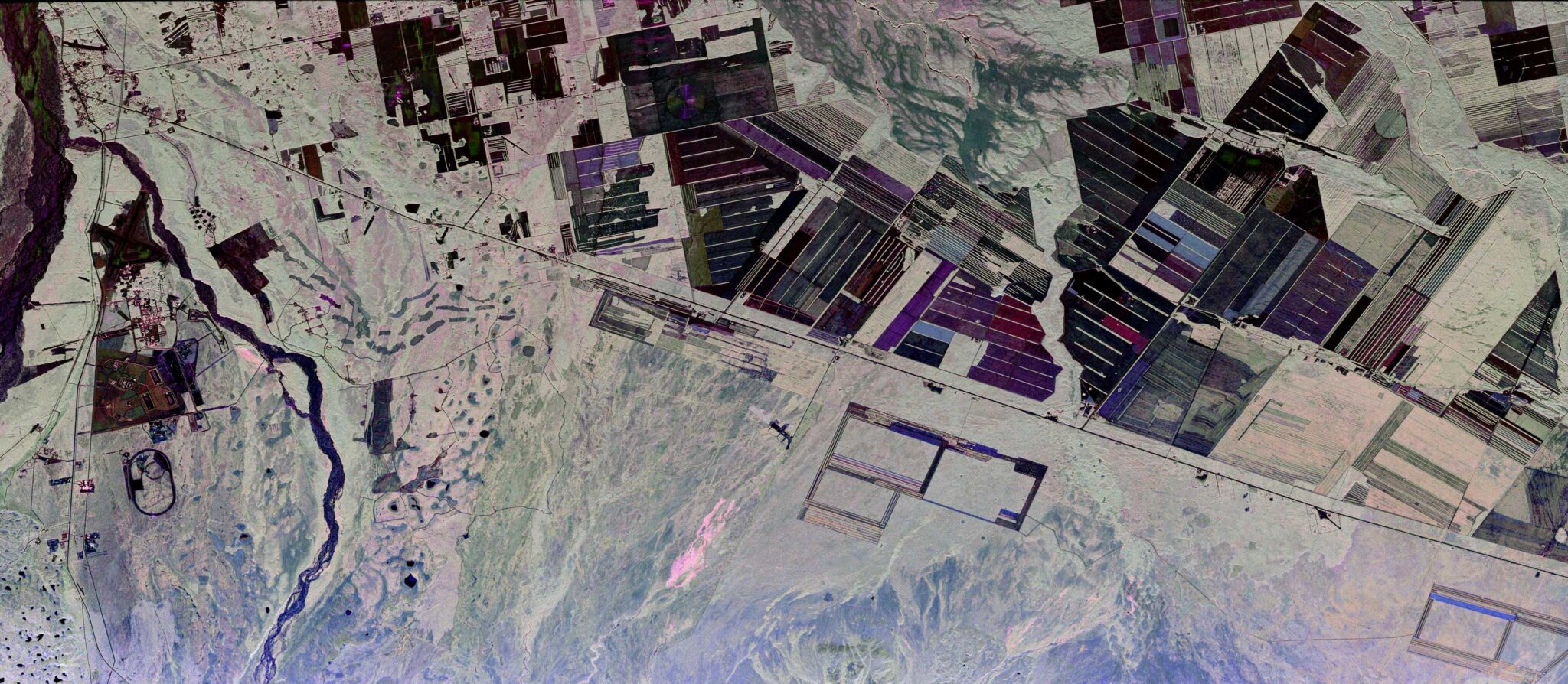
Location: Delta Junction, Alaska
Date(s): 2018
Spacecraft/Agency: UAVSAR / NASA.
Credit: NASA JPL 2018.
Delta Junction is a community of fewer than 1,000 people located in the interior of Alaska, about 160 kilometers (100 miles) southeast of Fairbanks. In the late 1970s and early 1980s, the State made large tracts of land in the area available for agricultural development. This UAVSAR Pauli decomposition shows the city in the upper left and agricultural fields along the Alaska Highway. The undeveloped Delta Junction Bison Range is located south of the highway.

Test Platform
Location: Mississippi River, Arkansas
Date(s): 2022
Spacecraft/Agency: UAVSAR / NASA.
Credit: NASA JPL 2022.
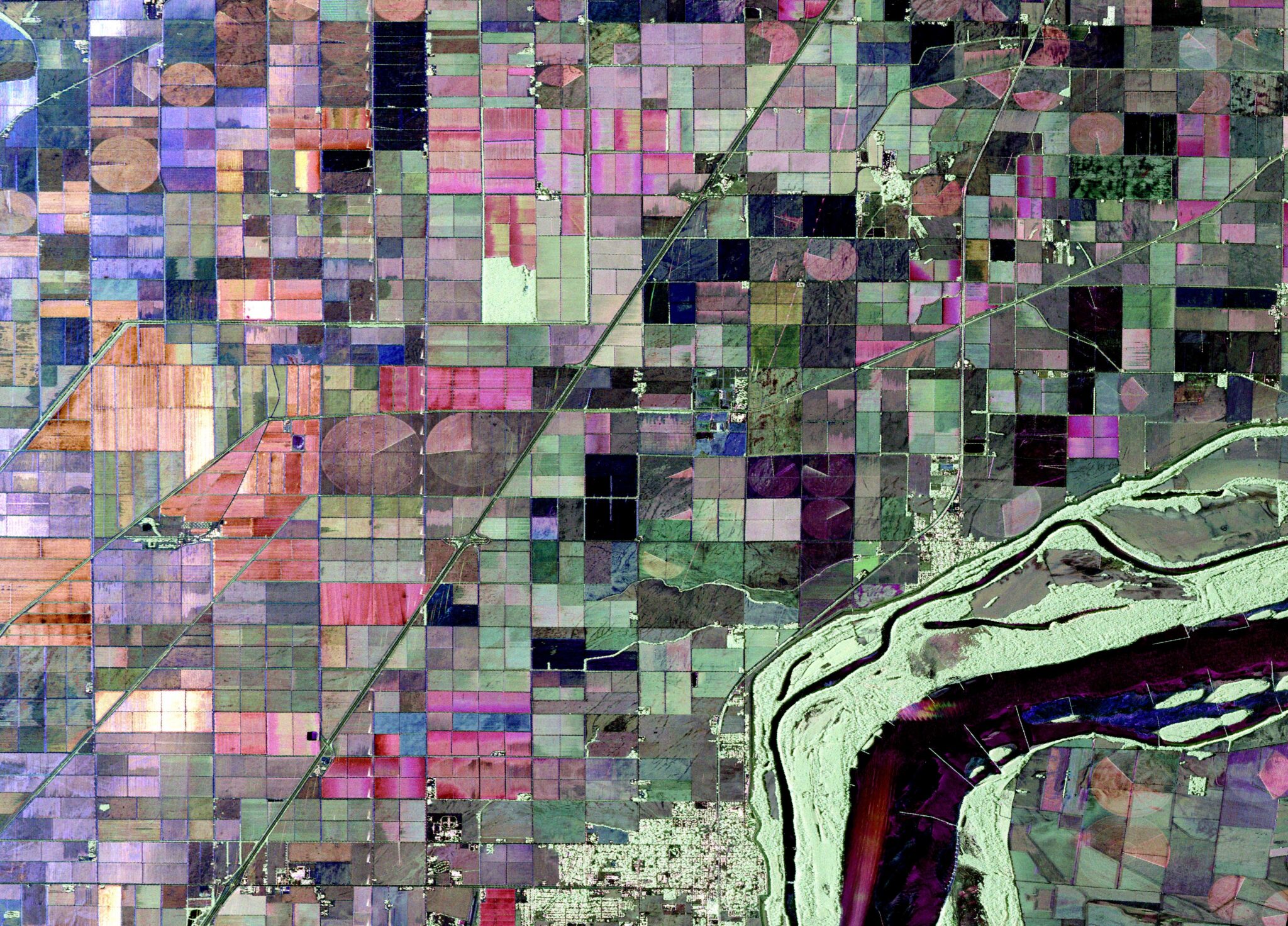
The JPL UAVSAR airborne platform was used to observe cropland sites across the southern U.S. to support the development of simulated NISAR Level 2 science products. NISAR is a forthcoming joint NASA-ISRO satellite mission that utilizes an L-band synthetic aperture radar instrument for Earth observation. Because UAVSAR also acquires imagery using L-band SAR, it was an ideal vehicle for use in developing these NISAR prototype products. The colorful patchwork of agricultural lands in this Pauli decomposition is located on the Mississippi River near the city of Osceola, Arkansas.
Multi-Temporal
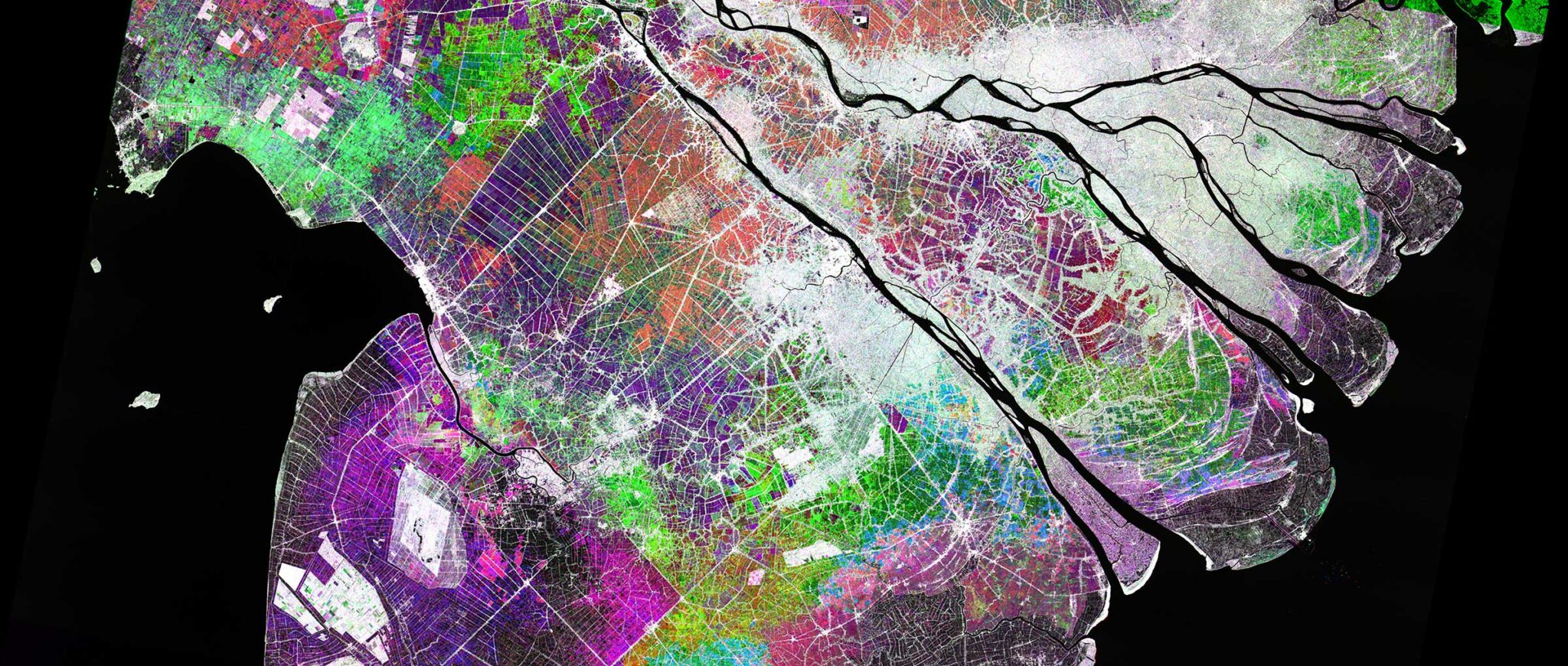
Location: Mekong River Delta
Date(s): 2019
Spacecraft/Agency: Sentinel-1 / European Space Agency (ESA).
Credit: Contains modified Copernicus Sentinel data 2019; courtesy R. Biessel.
This multi-temporal RGB composite uses three images of the Mekong Delta acquired at different times during the year. The colorful pixels represent temporal variation, while white-to-black pixels are areas that have not experienced significant change. The diversity of color highlights the region’s mix of crop types and the wide variety of rice cultivation methods. Because of the ability of SAR to image during the cloudy rainy season, this technique is a useful tool for mapping and classifying crop types and rice production methods year-round.